

Privacy Cannot Become a Shield Against Evidence
 Editor-in-Chief of indiacommentary.com. Current Affairs analyst and political commentator. Author of Cyber Scams in India, Digital Arrest, The Money Trap and The Human Hack
View all posts by this Author
Editor-in-Chief of indiacommentary.com. Current Affairs analyst and political commentator. Author of Cyber Scams in India, Digital Arrest, The Money Trap and The Human Hack
View all posts by this Author
By Sunil Garodia
First publised on 2026-07-04 13:25:53
About the Author
Editor-in-Chief of indiacommentary.com. Current Affairs analyst and political commentator. Author of Cyber Scams in India, Digital Arrest, The Money Trap and The Human Hack
View all posts by this Author
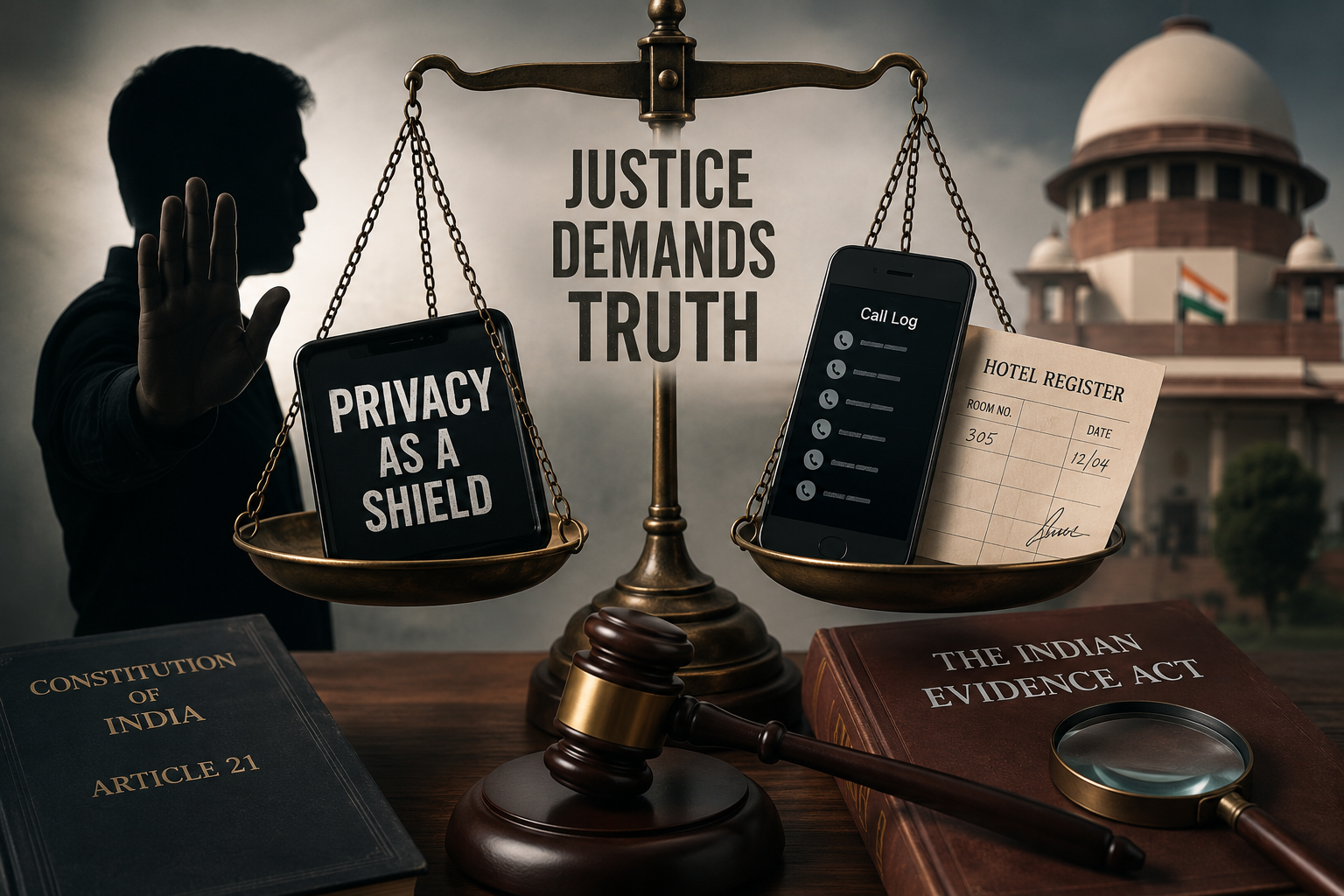
The Supreme Court's refusal this week to let a husband hide behind Article 21 while his wife tried to prove adultery is being reported as a privacy ruling, but it is really a ruling about what privacy is not for. A Bench of Justices Manmohan and K Vinod Chandran upheld a Delhi High Court order directing disclosure of mobile call records and hotel stay details, rejecting the argument that producing this material in court would itself violate the husband's fundamental right. The reasoning is unremarkable once stripped of its constitutional garb. A right invoked to prevent a court from seeing evidence relevant to the very question before it is not a right at all, it is a veto dressed up in Part III language.
Start with what the man was actually asking for. He was not resisting a search of his phone by the state, nor an intrusion by a stranger with no stake in the matter. He was resisting disclosure to a court, in a proceeding he is a party to, of material his own spouse says will prove a fact central to that proceeding. This is not privacy against the world. This is privacy against the opposite party in adjudication, which is a different animal altogether and one the Puttaswamy bench never intended to arm. Puttaswamy established that privacy is a fundamental right subject to a proportionality test, not an unconditional shield that switches on the moment a litigant finds a piece of evidence inconvenient. The Delhi High Court order, which the Supreme Court has now left undisturbed, applied exactly that limiting principle: privacy yields to reasonable restriction where public interest, or in this case the interest of a co-equal party's access to justice, is engaged.
The deeper problem with the husband's argument is that it would have converted Article 21 into a rule of evidence, which is not what constitutional rights are built to do. Relevance and admissibility in Indian courts are governed by the Evidence Act and its statutory successors, not by whether the party against whom the evidence cuts finds the constitution more comfortable to invoke than a straightforward denial. If a document is relevant to a fact in issue, its relevance does not evaporate because producing it embarrasses one side. Every matrimonial case, every property dispute, every commercial fraud claim would collapse into a game of selective constitutional objection if litigants could suppress inconvenient records this way. The court that tries adultery, cruelty, or dowry harassment already operates on a diet of call records, chat logs and hotel registers; that has been the working reality of family court litigation for years. What the husband sought was not privacy protection but a retroactive immunity from a category of proof his own conduct generated.
There is also a fairness asymmetry worth naming plainly. A wife alleging adultery carries the burden of proving it, and Indian matrimonial law does not extend her the comfort of a presumption; she must build her case brick by brick, usually against a spouse who controls most of the relevant material. To let that same spouse invoke privacy to withhold precisely the material she needs is to hand him both the wrongdoing and the ability to make it unprovable, which is not neutrality between two rights but a thumb on the scale for the party better positioned to hide the truth. A related order referenced in the same edition, in which a High Court leaned on a constitution bench ruling to hold that an extramarital relationship does not insulate a party from the consequences that flow within matrimonial proceedings, points toward the same underlying architecture, though the precise wording of that judgment deserves to be checked before it is cited with certainty. The direction of travel across these orders is consistent: courts are declining to let privacy operate as a device for defeating truth-seeking rather than protecting dignity from unwarranted intrusion.
None of this empties Article 21 of content. A hotel guest register subpoenaed to satisfy idle curiosity, or a call log sought by a stranger with no adjudicatory stake, would sit on entirely different constitutional footing, and the courts have been careful across a run of recent orders to keep that distinction intact rather than let one bleed into the other. What the Supreme Court has done is far narrower and, for that reason, entirely defensible: it has confirmed that once a person is inside a courtroom as a party to a dispute, the right to privacy cannot be repurposed into a right to prevent the court from doing its job. That does not mean every private record automatically becomes discoverable; courts must still ensure that disclosure remains proportionate, judicially supervised and confined to what is necessary to the fact in issue. Within that boundary, evidence relevant to an issue the parties themselves have put before a judge belongs to the proceeding, not to whichever side would rather it stayed hidden.
The lead picture is AI-generated