

The Exodus Mamata Banerjee Refuses to See
 Editor-in-Chief of indiacommentary.com. Current Affairs analyst and political commentator. Author of Cyber Scams in India, Digital Arrest, The Money Trap and The Human Hack
View all posts by this Author
Editor-in-Chief of indiacommentary.com. Current Affairs analyst and political commentator. Author of Cyber Scams in India, Digital Arrest, The Money Trap and The Human Hack
View all posts by this Author
By Sunil Garodia
First publised on 2026-07-12 12:08:19
About the Author
Editor-in-Chief of indiacommentary.com. Current Affairs analyst and political commentator. Author of Cyber Scams in India, Digital Arrest, The Money Trap and The Human Hack
View all posts by this Author
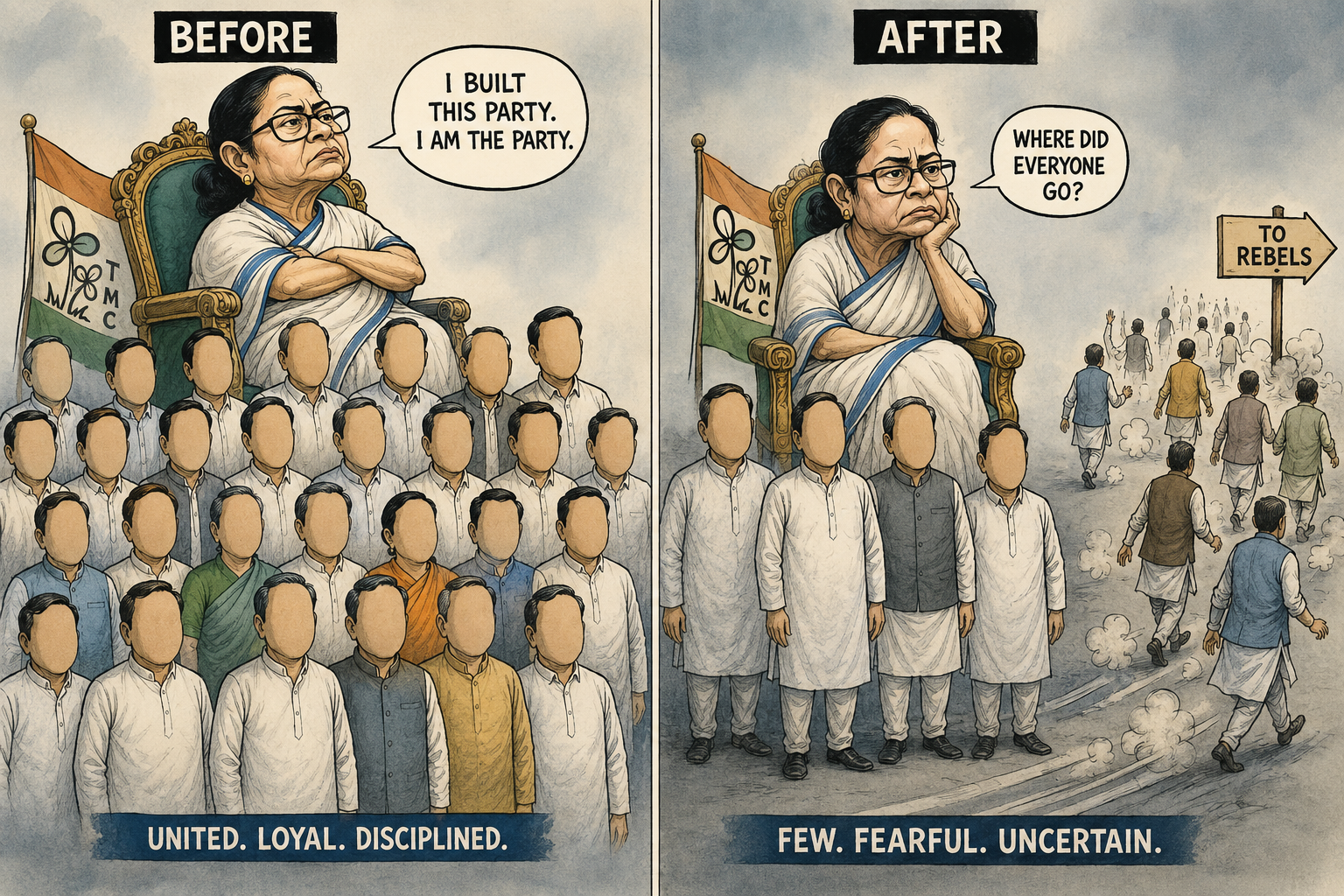
For a party that once prided itself on discipline and personal loyalty to one woman, the Trinamool Congress is unravelling in a manner few thought possible even six months ago.
One after another, senior leaders who built their political careers in Mamata Banerjee's shadow have either walked away, been pushed out, or aligned themselves with the rebel faction now openly challenging her authority. The list includes Firhad Hakim, Aroop Biswas, Arup Roy, Mala Roy, Sudip Bandyopadhyay and Kakoli Ghosh Dastidar. Kalyan Banerjee, her trusted lawyer, nearly walked too and was talked back only at the last moment.
Even Anubrata Mondal, the Birbhum strongman whose conduct Mamata Banerjee defended for years and who was once one of her most trusted organisational generals, has now joined the rebel camp, taking charge of its Birbhum unit. This is not routine political churn. It increasingly resembles a structural collapse, and Banerjee's insistence on blaming the BJP for engineering it is either self-deception or a refusal to face an uncomfortable truth in public.
There was a time when one or two defections could plausibly be laid at the BJP's door. Poaching is standard practice in Indian politics, and no party is above accepting a rival's disgruntled leader. But when a dozen or more of a chief minister's most trusted lieutenants leave in the space of weeks, when a rebel faction can claim the support of dozens of the party's own legislators and MPs, and when the person leading that rebellion is not a BJP operative but Ritabrata Banerjee, a TMC-appointed Leader of the Opposition, the "BJP engineered it" explanation stops being credible. Mass defections of this scale point inward, not outward.
Abhishek's chokehold on the machine
The first and most obvious reason is Abhishek Banerjee's near-total control over the party's organisational machinery. Over the past several years, ticket distribution, appointments and internal promotions have increasingly run through him rather than through the old guard that built the TMC from the ground up in the late 1990s and 2000s. Leaders like Aroop Biswas, who was central to the party's fundraising operations and was long considered one of Mamata Banerjee's most trusted hands, found themselves answering to a chain of command built around her nephew rather than around her. For a generation of TMC leaders who joined the party because of their personal relationship with Didi, being managed by her nephew's aides was never going to sit well, however much they kept it to themselves in public.
The moment that broke the illusion
The second reason is more damaging, because it strikes at the heart of Banerjee's own authority. After the TMC's defeat in the recent Assembly elections, a party meeting was convened, and multiple leaders have since described it as the real trigger for the rebellion. Senior figures were reportedly told that no criticism of Abhishek Banerjee would be tolerated, that he had performed exceptionally despite the loss, and that the room was expected to rise and applaud him. For many leaders present, some of them founding members of the party with decades in public life, this reportedly became the moment the perception changed irrevocably: being ordered to stand and clap for a defeat, rather than being allowed to ask hard questions, was not something they were willing to accept quietly. Several rebel leaders have since said as much publicly.
Taken together with the broader shift in decision-making, it suggests many within the party now believe operational authority has moved decisively to Abhishek Banerjee, leaving Mamata Banerjee to preside in name more than in practice. Whatever the precise truth of that perception, a leader who cannot tolerate her own senior colleagues questioning her nephew after an electoral drubbing is not projecting full command of her party.
Bengal's winner-takes-all culture
The third reason is structural and predates both Mamata Banerjee and Abhishek Banerjee. West Bengal's political culture has long operated on a winner-takes-all logic, in which proximity to power determines survival and loss of power triggers an immediate scramble to find the next patron. Political migration in Bengal has rarely been ideological; it has almost always followed the perceived direction of power. This is exactly how the Congress bled cadres to the CPI(M) in the 1970s and how the CPI(M) itself bled cadres to the TMC after 2009 and 2010. Local leaders, block committee members and municipal councillors do not stay loyal to an ideology; they stay loyal to whoever can protect their local interests and deliver patronage. Once it becomes clear that a party is losing its grip on the state machinery, the exit doors open fast, and loyalty that looked unshakeable a year earlier evaporates within weeks. What is happening to the TMC now is not new to Bengal. It is the same current that has eventually swept away every dominant party in the state, and Banerjee, who benefited from exactly this dynamic when she dismantled the Left's decades-long dominance, should know it better than anyone.
The cost of denial
None of this means the BJP is a passive bystander. Any opposition party would try to capitalise on a rival's internal crisis, and it would be naive to assume the BJP is not actively courting disillusioned TMC leaders. But there is a difference between exploiting a crack and creating one, and the scale of what is unfolding inside the TMC cannot be explained by external interference alone. Leaders who spent twenty or thirty years building the party from scratch do not walk away over a phone call from a rival camp. They walk away when the internal calculus of loyalty, access and future security stops adding up in their favour.
By pinning the blame entirely on the BJP, Mamata Banerjee is doing her party a disservice at the precise moment it needs honest introspection. Denial does not stop the bleeding; it accelerates it, because every leader still inside the tent watches the official explanation and draws its own conclusions about whether the party's problems are actually being addressed. If Banerjee wants to arrest this slide, the fix has to start with her own household, not with a press conference denouncing saffron conspiracies. She built the TMC by breaking away from a party that stopped listening to its own workers. It would be a bitter irony if the same instinct that built her party is now the one dismantling it, simply because she has stopped listening too.
The lead image is AI-generated