

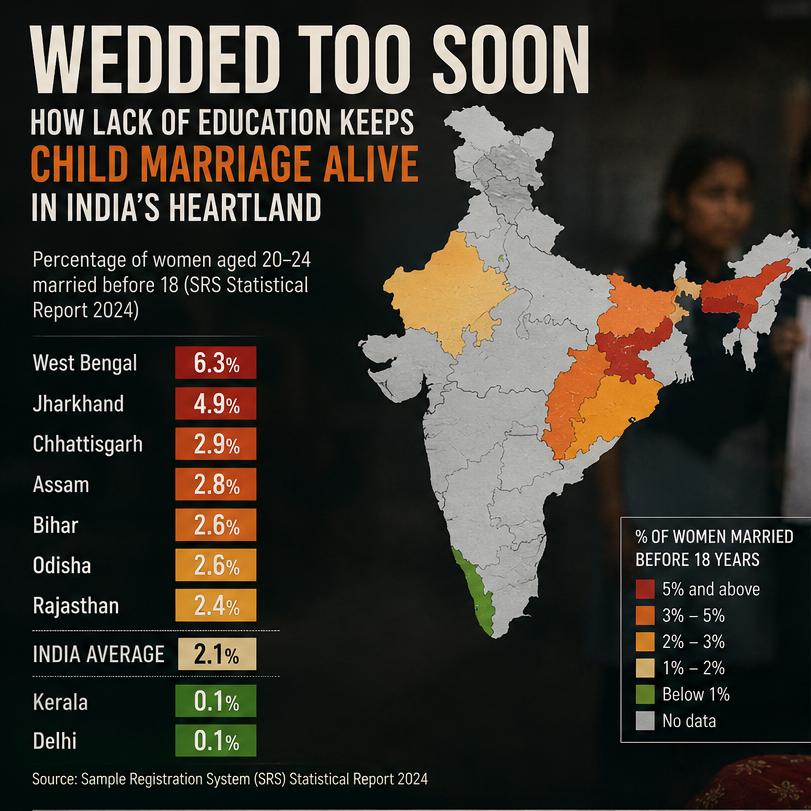

When a girl stays in school, she stays out of a husband's house. It is a simple truth that decades of research have confirmed, yet one that large swathes of India are still struggling to act upon. New data from the Sample Registration System (SRS) Statistical Report 2024 lays bare a troubling reality: one in sixteen girls in West Bengal is married before she turns eighteen. Across the eastern and central belt - Jharkhand, Chhattisgarh, Assam, Bihar, Odisha, Rajasthan - the numbers tell a similarly grim story. Meanwhile, Kerala and Delhi, where girls routinely complete higher education, report rates close to zero.
The Same Map, Twice Over
West Bengal tops the table at 6.3% - three times the national average of 2.1%. Jharkhand follows at 4.9%, then Chhattisgarh (2.9%), Assam (2.8%), Bihar and Odisha (2.6% each), and Rajasthan (2.4%). Every one of these states lies in India's eastern or central corridor. They are also, without exception, among the states with the lowest female literacy rates, the fewest secondary schools in rural areas, and the highest rates of girl dropouts. The geography of child marriage and the geography of poor female education are, for the most part, the same map.
In Jharkhand and Chhattisgarh, large tribal populations live far from secondary schools - girls who finish primary often have nowhere to continue. In Assam, flooding and seasonal migration disrupt schooling, and tea-garden girls face acute barriers. In West Bengal's worst-affected districts - Murshidabad, Malda, Uttar Dinajpur - persistent poverty and patriarchal norms mean a daughter's marriage is still seen as a financial necessity rather than a social tragedy. West Bengal's grim ranking carries another shadow that statistics rarely capture fully. The state is one of India's most significant source regions for human trafficking, and the two crises are deeply intertwined. Girls from the same districts that lead child marriage figures are disproportionately represented among trafficking victims. In many cases, early marriage itself is used as a cover: a girl is "married off" to a man who is, in fact, a trafficker. Poverty, lack of schooling, and the absence of economic alternatives make adolescent girls acutely vulnerable. Until the conditions that drive child marriage are addressed, the trafficking pipeline from Bengal's borderland districts will remain very difficult to shut down.
The Price Girls Pay
Child marriage is a health emergency, an economic trap, and a human rights violation rolled into one. Adolescent mothers are twice as likely to die in childbirth as women in their twenties, and their infants are more likely to be born underweight, perpetuating a cycle of poor health across generations. Marriage almost invariably ends a girl's schooling, leaving her financially dependent on her husband and in-laws - a dependency that can enable abuse. Young brides isolated from their natal families are disproportionately vulnerable to domestic violence, with little means to seek help. And the psychological toll is profound: forced into adult roles before they have the maturity to cope, child brides suffer higher rates of depression and anxiety. Perhaps most fundamentally, they are denied the right to shape their own lives - their voices silenced at precisely the age when they should be discovering them.
The Wind is Changing - But Not Fast Enough
There is reason for cautious optimism. India's national average has fallen considerably over two decades. Schemes like Beti Bachao Beti Padhao and the Kasturba Gandhi Balika Vidyalayas - residential schools for girls from marginalised communities - have contributed to a measurable shift. More girls than ever are attending secondary school, and mobile phones have given young women in rural areas access to information and awareness of their legal rights. States like Rajasthan have shown real improvement; Tamil Nadu and Karnataka, both below 1%, demonstrate what sustained investment in female education can achieve.
But the pace remains insufficient. A national average of 2.1% sounds small until you remember India's population - in absolute numbers, hundreds of thousands of girls are still being married off before adulthood every year. The data also masks extreme local concentrations where rates remain catastrophically high. Progress is real. The work, however, is far from done.
The lead image is generated via AI