


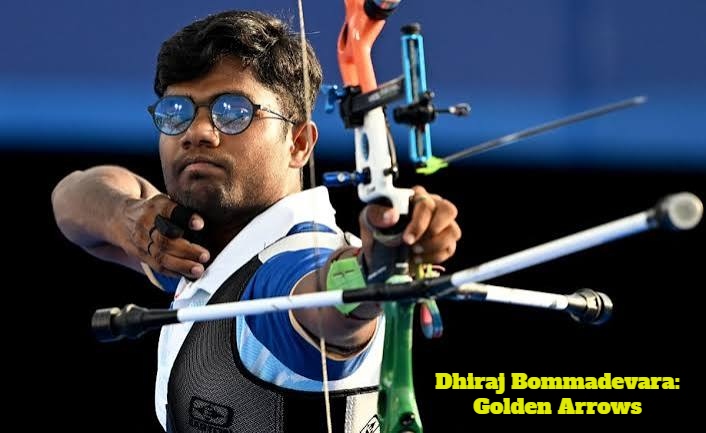
Dhiraj Bommadevara's Golden Breakthrough Signals a New Era for Indian Archery
 Linus tackles things head-on. He takes sides in his analysis and it fits excellently with our editorial policy. No 'maybe's' and 'allegedly' for him, only things in black and white.
View all posts by this Author
Linus tackles things head-on. He takes sides in his analysis and it fits excellently with our editorial policy. No 'maybe's' and 'allegedly' for him, only things in black and white.
View all posts by this Author
By Linus Garg
First publised on 2026-06-15 08:14:06
About the Author
Linus tackles things head-on. He takes sides in his analysis and it fits excellently with our editorial policy. No 'maybe's' and 'allegedly' for him, only things in black and white.
View all posts by this Author
For years, Indian archery has lived in the shadow of South Korea's near-total domination of the sport. Every Indian archer who has dreamt of standing atop the podium has had to confront the Korean challenge sooner or later. On Sunday in Antalya, Turkey, Dhiraj Bommadevara did not merely confront it - he conquered it.
The 24-year-old Olympian scripted one of the finest performances by an Indian recurve archer in recent years, winning two gold medals at the Archery World Cup Stage III and firmly establishing himself among the world's elite. In a single day, Dhiraj captured the recurve mixed team title alongside teenage sensation Kumkum Mohod and then followed it up with the men's individual gold medal, producing a landmark achievement for Indian archery.
The first gold came in the mixed team event, where Dhiraj and Kumkum faced the daunting South Korean pair of Kim Je-deok and Oh Ye-jin - the reigning Olympic champions and representatives of the most successful archery nation in history. Few gave the Indians much chance against such decorated opponents.
Yet the Indian duo displayed remarkable composure. Set after set, they matched the Koreans arrow for arrow before eventually prevailing 5-1. Dhiraj's final arrows under pressure reflected the confidence of an athlete entering his prime years, while Kumkum showed maturity far beyond her age. The victory was not merely another medal; it was a statement that India can now challenge and defeat South Korea in recurve archery's biggest contests.
If the mixed team gold demonstrated India's collective strength, the men's individual title showcased Dhiraj's personal brilliance.
Facing South Korea's Lee Woo-seok, a Paris Olympics bronze medallist and one of the sport's most accomplished competitors, Dhiraj delivered a performance of exceptional quality. He won the final 7-3, displaying the consistency, temperament and technical excellence that define champions. The victory earned him his maiden individual World Cup gold medal and completed an unforgettable golden double.
For followers of Indian archery, Dhiraj's success has been years in the making.
Born in Vijayawada, Andhra Pradesh, Dhiraj entered archery as a child and steadily climbed the international ladder. He emerged as one of India's brightest prospects through strong performances at the Asian Games, World Cups and international championships. At the Paris Olympics in 2024, he narrowly missed a medal in the mixed team event, a disappointment that could easily have broken a lesser athlete. Instead, it appears to have strengthened his resolve.
The Antalya triumph is especially significant because it represents the conversion of promise into achievement. Dhiraj had previously collected silver and bronze medals at major events, but the elusive World Cup gold had remained beyond reach. By winning two gold medals in one tournament, he has crossed an important psychological barrier and demonstrated that he possesses the ability not merely to compete with the world's best but to defeat them consistently.
His achievement also reflects the broader transformation taking place within Indian archery.
For decades, India produced talented archers who often fell short in crucial moments against traditional powerhouses such as South Korea. Recent years, however, have witnessed a noticeable shift. Young archers are displaying greater self-belief, improved technical preparation and enhanced mental toughness. India's women's recurve team stunned South Korea in Shanghai earlier this year, and now Dhiraj and Kumkum have repeated the feat on another major stage.
The significance of Antalya extends beyond the medals themselves. The Asian Games are approaching, and the World Championships are never far away. Victories over Korean opponents in high-pressure finals provide invaluable confidence and send a message to rival nations that India is no longer content with merely challenging for podium places.
Dhiraj's double gold is therefore more than a personal milestone. It represents a moment of validation for Indian archery's long-term investment in talent development and international exposure. It offers proof that Indian recurve archers can stand shoulder to shoulder with the sport's traditional giants.
For Dhiraj Bommadevara, Antalya may well be remembered as the tournament that transformed him from a promising international competitor into a genuine global champion. For Indian archery, it could mark another step towards a future in which victories over South Korea are celebrated not as miracles, but as evidence of a new sporting reality.
The road to Olympic glory remains challenging. But after Antalya, it is a road that appears considerably shorter than before.