Leave Consenting Adults Alone
 Editor-in-Chief of indiacommentary.com. Current Affairs analyst and political commentator. Author of Cyber Scams in India, Digital Arrest, The Money Trap and The Human Hack
View all posts by this Author
By Sunil Garodia
First publised on 2026-11-19 06:53:18
About the Author
Editor-in-Chief of indiacommentary.com. Current Affairs analyst and political commentator. Author of Cyber Scams in India, Digital Arrest, The Money Trap and The Human Hack
View all posts by this Author
A hotel room in Seoni in Madhya Pradesh, a couple who had broken no law, and a senior police officer who, on camera, allegedly decided that the quickest way to win an argument was to manufacture a crime. Strip away the viral outrage and the episode exposes two failures at once: a policing culture that does not respect privacy, and a system that rarely punishes those who violate it.
What the footage shows
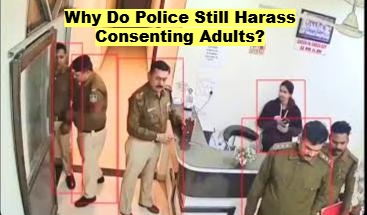
CCTV footage, believed to be from 13 November, shows Additional Superintendent of Police Deepak Mishra, SDOP Chanchalesh Markam and Kotwali TI Satish Tiwari questioning an unmarried adult couple at a hotel in Seoni. The couple reportedly told the officers they were adults who planned to marry. When they declined to call their families, and the woman declined to unlock her phone, Mishra is reportedly heard telling his men to plant ganja on the man. He is said to have first dismissed the video as AI-generated. On Wednesday, Chief Minister Mohan Yadav ordered six policemen suspended. These remain allegations until an inquiry says otherwise, but the suspensions suggest the footage is being treated as genuine.
No law was broken in that room
Indian law does not criminalise two consenting adults taking a hotel room. The Supreme Court made privacy a fundamental right in Puttaswamy (2017), including the freedom to make intimate choices. In Joseph Shine (2018) it struck down the adultery law, and the Court has long held, from Lata Singh (2006) to Shakti Vahini (2018), that adults choose their own partners without the permission of parents, neighbours or police. In S. Khushboo (2010) it said premarital relationships and live-in arrangements are not offences. The public-obscenity provisions need a public place, and a booked room is not one. No statute requires a marriage certificate to check in or parental consent to be an adult.
So what, exactly, was being enforced? Ordering adults to phone their parents and marry "today itself" is not law enforcement. It is moral instruction delivered with the authority of the state, and it is the kind of coercion Lata Singh told the police to stop.
Three separate violations
The demand to unlock a phone was the first. Police cannot simply compel it from a guest who is not accused of any offence. Seizure requires lawful procedure, and compelled passcodes raise real questions under Articles 20(3) and 21.
The threat to plant ganja was the second, and the gravest. Fabricating evidence and criminal intimidation are offences in themselves, and a drugs case is not an idle threat. Under the NDPS Act, bail can be hard to obtain where the quantity alleged is large, so a planted packet can cost a young man months of his life before a court even hears the truth. That is the point of the threat: it works because the process is the punishment.
The third is the one nobody will be charged with: the humiliation. A couple's most private hour was turned into a spectacle for officers, a hotel manager and, eventually, the internet.
Why it keeps happening
This is my reading, not a finding. Moral policing is cheap and popular, and it needs no complaint, no evidence and no paperwork. Couples rarely report such encounters because they fear their families, social shame and the very officers they would be complaining against. That silence makes the officer's calculation easy. Where it shades into extortion, the couple's fear becomes the officer's leverage.
The Seoni case surfaced only because the hotel's own cameras caught it. The reports also mention a dispute between the police and the hotel owner, and an earlier clip in which the station in-charge allegedly threatened the manager with closure. The inquiry must establish whether this was a morality raid at all, or an exercise of leverage over a hotel dressed up as one. Either answer indicts the conduct.
What accountability should mean
Suspension is an administrative step, not accountability. A credible response has four parts.
1. An FIR, not just a departmental inquiry, under the provisions on fabricating evidence and criminal intimidation, investigated by someone outside the Seoni police hierarchy.
2. A time-bound report, made public, covering every officer on the footage and the dispute with the hotel.
3. Clear instructions to every district: no entry into a lawful booking without a complaint or a warrant, no phone searches without procedure, no calls to parents of adults.
4. Protection for the couple. They are the victims here. Their identities should not be dragged into the case, and no one should be allowed to retaliate against them.
The larger reform has been pending since the Prakash Singh directions of 2006: independent complaint authorities, fixed tenures and a separation of investigation from law and order. Until police can be held to account by someone other than their own seniors, viral videos will remain the only oversight that works.
The test
A state that cannot let two adults close a door behind them has no business claiming it protects its citizens. The measure of Seoni will not be how fast six officers were suspended. It will be whether the next couple in the next hotel room, in a town with no CCTV and no viral video, can trust that the law stops at their door.