Rs 80 Lakh For A Rs 5 Note: Latest Bait On Social Media To Extract Money And Personal Data
 Editor-in-Chief of indiacommentary.com. Current Affairs analyst and political commentator. Author of Cyber Scams in India, Digital Arrest, The Money Trap and The Human Hack
View all posts by this Author
By Sunil Garodia
First publised on 2026-11-21 13:09:07
About the Author
Editor-in-Chief of indiacommentary.com. Current Affairs analyst and political commentator. Author of Cyber Scams in India, Digital Arrest, The Money Trap and The Human Hack
View all posts by this Author
Imagine being offered Rs 80 lakh for a Rs 5 currency note. All you have to do, apparently, is provide your address, a photograph and Rs 750 as registration fees. Within 24 to 48 hours, a team will arrive at your doorstep, hand over Rs 80 lakh in cash and collect the note. It sounds like an extraordinary opportunity. In reality, it is an elaborate advance-fee fraud that exploits greed to extract money and sensitive personal information from unsuspecting people.
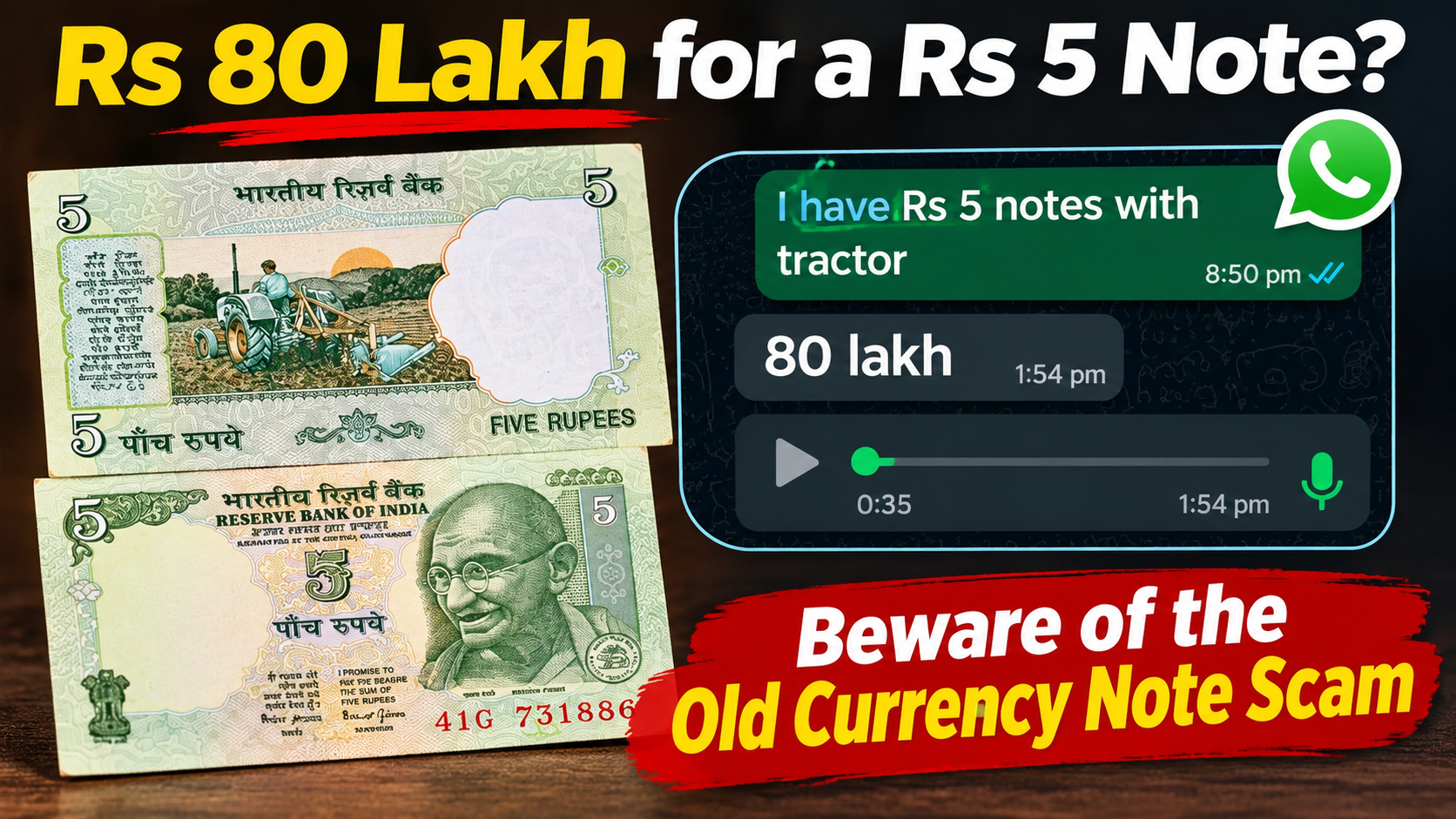
I recently encountered one such offer on Instagram. The advertisement promised an astronomical sum for an old Rs 5 currency note featuring a tractor on its reverse. Intrigued by the audacity of the claim, I decided to engage with the purported buyer to understand how the operation worked. What followed provides a revealing insight into the mechanics of this scam.
The bait is an offer that sounds too good to refuse. After establishing contact through WhatsApp, I informed the person that I was from Kolkata and possessed Rs 5 notes featuring a tractor. The response was a request to send a photograph. When I clarified that I had a currency note and not a coin, I sent photographs showing both sides of the note.
The response was immediate and unequivocal: "80 lakh".
There was no discussion about the note's condition, serial number, rarity or any independent assessment of its value. The purported buyer simply confirmed the promised amount after seeing the photograph. The next step was to explain the procedure for completing the transaction.
A voice message reveals the modus operandi. The person sent a 35-second WhatsApp voice message in Hindi. Its contents are worth reproducing because they expose the carefully constructed procedure being used to lend credibility to the offer.
Translated into English, the message said:
"You will receive the price that I have quoted you. Let me explain the procedure for selling the note. You have to provide your complete residential address along with the PIN code. You must also provide a selfie, a small passport-size photograph of yourself. You then have to deposit Rs 750 as registration fees. Once the NOC card is issued, within 24 to 48 hours our team will visit the full address that you provide and you will receive the payment in cash at your home."
The sequence is significant. First comes the confirmation of Rs 80 lakh. Then comes the demand for the complete residential address and PIN code. A photograph is required, followed by a registration payment of Rs 750. Finally, the caller promises that a team will arrive within 24 to 48 hours with the cash.
The voice message is designed to remove the last vestiges of doubt. The promise of a team visiting the buyer's own home and making payment in cash makes the transaction appear tangible. The reference to an NOC card gives it an official-sounding dimension. The modest registration fee seems insignificant when set against the promised fortune.
But the Rs 750 is the real target. The Rs 80 lakh is merely bait.
The NOC is the centrepiece of the deception. The purported buyer does not explain which government department is supposed to issue this NOC, under what law it is required, or why a private sale of an old currency note needs such a clearance. No verifiable government authority is identified in the voice message. The term is simply introduced as an essential step in the transaction.
There is no legitimate RBI registration or government NOC procedure of the kind described for selling an old currency note to a private buyer. The Reserve Bank of India has repeatedly cautioned the public against fictitious offers to buy or sell old banknotes and coins. In its public warning of August 4, 2021, the RBI clarified that it does not deal in such transactions, does not charge any commission or fee, and has not authorised any person or agency to collect money on its behalf.
The distinction is important. Old notes and coins can have numismatic value, and genuine collectors do buy and sell them. But that does not lend credibility to extraordinary valuations circulated through anonymous social media accounts. Nor does it establish the existence of a government clearance procedure or justify advance payments to an unidentified intermediary.
The financial trap may be only the beginning. The demand for Rs 750 is accompanied by a request for information that deserves even greater concern. The fraudster wants the victim's full residential address, PIN code and photograph. In the initial description of the transaction, Aadhaar details were also sought, ostensibly for registration and obtaining the NOC.
A person tempted by the prospect of receiving Rs 80 lakh may willingly hand over all these details. But such information can potentially be used for impersonation, identity fraud, targeted phishing and other forms of deception. A residential address also tells criminals where a potential victim lives.
Once the registration fee is transferred, the victim could be asked for additional amounts under different pretexts, including processing charges, taxes, certificate fees or other invented expenses. Alternatively, the account may simply stop responding. The promised team, the NOC card and the Rs 80 lakh payment may never materialise.
The relatively small initial demand is what makes this fraud effective. A person who believes that a fortune is within reach may not think twice about paying Rs 750. The fraudster is betting on precisely that suspension of judgment.
The RBI warning has not eliminated this business. Fraudulent advertisements offering extraordinary sums for old currency notes have circulated on social media for years. The RBI's warning in 2021 specifically addressed fictitious offers involving old notes and coins. Yet the same basic formula continues to reappear, with different promised amounts and variations in the supposed registration process.
The problem is not simply that people are unaware of such warnings. These operators understand how to manufacture credibility. They use photographs of genuine currency, communicate through WhatsApp, provide a seemingly definite valuation and explain a transaction procedure in a confident manner. The use of voice messages makes the interaction appear more personal and convincing than a generic advertisement.
Instagram and other social media platforms cannot treat such promotions as harmless user-generated content. Advertisements soliciting money through implausible financial promises and demanding identity documents need closer scrutiny. Accounts involved in such activity should be investigated, and payment trails should be examined wherever complaints are received.
There is a simple test that can save people from this trap. If someone is genuinely willing to pay Rs 80 lakh for a Rs 5 note, why should the seller have to pay Rs 750 first? Why does a private buyer need an unexplained government NOC? Why must the seller surrender personal identity documents before even meeting the buyer?
These are questions that should be asked before responding to such offers, not after money has been transferred.
Nobody should pay registration, processing or NOC charges to an unknown person promising to buy old currency. Do not share Aadhaar details, photographs or residential addresses with unverified buyers. Anyone who has already transferred money should immediately contact the national cybercrime helpline at 1930 and report the incident through the National Cyber Crime Reporting Portal. All WhatsApp messages, voice recordings, telephone numbers, Instagram account details and payment records should be preserved as evidence.
The promise of Rs 80 lakh is meant to make Rs 750 look like a trivial investment. It is not an investment. It is the entry price to a deception.
The buyer is not interested in your old currency note. The buyer is interested in your money and your personal information. By the time you realise that there is no fortune coming your way, the fraudster may already be looking for the next person willing to believe the impossible.