

Satluj and the Censorship That Will Not Give Its Name
 Editor-in-Chief of indiacommentary.com. Current Affairs analyst and political commentator. Author of Cyber Scams in India, Digital Arrest, The Money Trap and The Human Hack
View all posts by this Author
Editor-in-Chief of indiacommentary.com. Current Affairs analyst and political commentator. Author of Cyber Scams in India, Digital Arrest, The Money Trap and The Human Hack
View all posts by this Author
By Sunil Garodia
First publised on 2026-07-06 02:21:43
About the Author
Editor-in-Chief of indiacommentary.com. Current Affairs analyst and political commentator. Author of Cyber Scams in India, Digital Arrest, The Money Trap and The Human Hack
View all posts by this Author
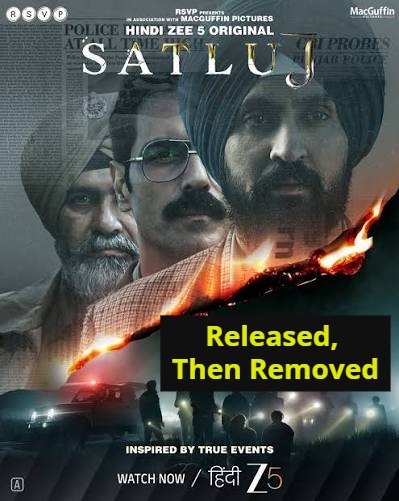
Honey Trehan's Satluj, which the world came to know for nearly four years under its censor-appointed title of Punjab '95, finally reached Indian audiences on Zee5 on the evening of Friday, July 3, in the uncut version that the Central Board of Film Certification had spent the better part of four years trying to prevent. By Sunday evening, it was gone. Zee5's own statement, when it came, was a study in studied vagueness: the film would be "unavailable in India until further notice" owing to "the current developments," a phrase that explains nothing while appearing to explain something.
No government order has been placed in the public domain. No group has stepped forward to claim credit or blame for the film's disappearance. What remains is a film that was cleared for nothing, banned by no one in particular, and removed all the same.
The film's journey through India's certification apparatus is itself the more damning story, and it deserves to be recalled in full before the events of this weekend are assessed. Submitted to the CBFC in 2022 under the title Ghallughara, a word that Punjabi collective memory reserves for the great massacres of the community, the film was made to change its name once before it ever reached a cinema screen. The board is reported to have sought some 127 cuts, and the nature of those cuts is instructive: not violence trimmed for a certificate, but names excised, place references removed, and the very phrases "extra-judicial killings" and "human rights" struck out as though the words themselves were the offence rather than the history they described. Amid this prolonged dispute, the film also lost its invitation to a gala premiere at the Toronto International Film Festival in 2023. That a film based on a matter already settled by the Central Bureau of Investigation and by the courts, which convicted a handful of police officers for the murder of Jaswant Singh Khalra, should have required four years of negotiation merely to be seen in its original form tells its own story about where the instinct to suppress operates most freely: not at the level of fact, which the CBI had already established, but at the level of memory, which official Punjab has evidently preferred to keep unspoken.
Khalra's own family did not share that preference. Paramjit Kaur Khalra, his widow, issued a statement welcoming the film's release, noting that the version streaming on Zee5 was the same one first shown to the family and that its spirit had survived "immense pressure and repeated attempts to make changes."
Her endorsement matters because it removes the film from the register of speculative fiction and places it where it belongs, as a dramatised account of events that have already been investigated, litigated and, in substantial part, adjudicated. Once a society has allowed its courts to establish a set of facts, it has little standing to prevent those same facts from being narrated to its citizens in another form.
What makes the weekend's removal more troubling than a straightforward act of censorship is precisely its lack of straightforwardness. India's theatrical certification regime, whatever its faults, at least operates through a named authority, a stated process and an appellate route to the courts, all of which RSVP had in fact exhausted over four years. Streaming platforms operate under the IT Rules' three-tier regulatory framework rather than the statutory certification process administered by the CBFC. In practice, however, that framework often leaves opaque decisions without the transparency that accompanies formal certification. The irony is difficult to miss. A framework created to avoid pre-certification has produced a result that is, from the viewer's perspective, even less transparent. A film can disappear without any publicly available order identifying who required its removal or why. Zee5's statement that it is exploring "every appropriate avenue through due process" to restore the film is candid about the fact that no due process attended its removal in the first place.
The honest answer to the question of who is behind this is that the public record does not yet say.
Shiromani Akali Dal president Sukhbir Singh Badal called the removal "arbitrary," a description that fits the available facts better than any theory of a specific hidden hand, because arbitrariness is what a decision looks like when its authorship cannot be established. It is entirely possible that an informal word was had with the platform, by an official acting without paper, or by a political actor with no office to answer for. It is equally possible that the platform, having released the film and watched the reaction it provoked, chose on its own account to withdraw it rather than wait to be told to. Both possibilities point to the same institutional failure, which is that a piece of cinema depicting the excesses of state power was made to disappear through a channel that leaves no trace for anyone, including the courts, to examine.
This is where the argument against bans of this kind acquires its force, and it is worth stating plainly rather than as a rhetorical flourish. A ban that cannot be named cannot be challenged, and content that disappears without an order behind it teaches a lesson considerably more chilling than one that is formally proscribed: that visibility itself is conditional on a silence nobody is required to explain.
Suppressing a dramatisation of events that the CBI has already investigated and the courts have already partly adjudicated does not protect any institution from scrutiny that has, in fact, already occurred. It merely denies ordinary citizens the occasion to encounter, in a form built for public engagement, a chapter of Punjab's history that their own investigative agencies and courts have already established. If the government or any of its agencies has a genuine objection to Satluj's content, that objection ought to be reduced to a written order, subject to appeal, in the manner the CBFC process itself makes available. Absent that, what the country has witnessed is not the exercise of any lawful authority but its avoidance, and a government or a platform that prefers avoidance to accountability invites exactly the suspicion that transparency would have foreclosed.