

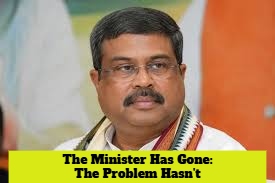
The Minister Has Gone. The Problem Hasn't
 Editor-in-Chief of indiacommentary.com. Current Affairs analyst and political commentator. Author of Cyber Scams in India, Digital Arrest, The Money Trap and The Human Hack
View all posts by this Author
Editor-in-Chief of indiacommentary.com. Current Affairs analyst and political commentator. Author of Cyber Scams in India, Digital Arrest, The Money Trap and The Human Hack
View all posts by this Author
By Sunil Garodia
First publised on 2026-07-25 13:09:24
About the Author
Editor-in-Chief of indiacommentary.com. Current Affairs analyst and political commentator. Author of Cyber Scams in India, Digital Arrest, The Money Trap and The Human Hack
View all posts by this Author
Dharmendra Pradhan is no longer Education Minister. That question has been settled. The harder one has not. Has the examination system that produced this crisis actually been repaired?
Start with how the resignation happened, because the sequence complicates the government's version of events. Reports first suggested Pradhan would simply be shifted to another portfolio in a Cabinet reshuffle. Governments do this often: absorb the pressure, reassign the minister, leave the underlying system untouched. Rahul Gandhi shut that door in public. A transfer, he said, would not be acceptable to the students, who wanted Pradhan out of government entirely, not moved to a different desk within it. Two days later, Pradhan resigned. Not the government's first choice. The fallback, once the easier option had already been ruled out on the record.
It didn't arrive alone either. A day before Pradhan quit, the Centre began removing 47 officials from the National Testing Agency, the first phase of what's being described as a wider restructuring, with legal and criminal proceedings reportedly likely for some of them. Nobody needs to prove the NTA purge caused the resignation for the sequence to matter. Once the officials running the agency under his ministry were being removed, the political position of the minister who had spent weeks defending that agency inevitably became harder to sustain. Bureaucrats first. The minister above them second. That the departure followed so quickly doesn't require conspiracy to be worth noticing.
None of this is the reform the protest was actually demanding.
A resignation changes who holds an office. Sacking 47 officials removes specific people. Neither answers the questions that actually caused this crisis: can the NTA's outsourcing arrangements be made leak-proof, will question papers travel through an encrypted chain of custody, will an independent body audit examinations going forward, will leak investigations run on a fixed timeline instead of dragging for months the way this one did. Those are institutional questions. Their answers determine whether future examinations command public confidence, regardless of who occupies the minister's office. The government has gestured toward some of this. A Cabinet-approved bill on exam malpractice is moving. A high-level committee's recommendations are apparently being implemented, starting with recruitment for security and transparency roles. The rebuilding has also taken a different shape from a typical bureaucratic reshuffle. Senior General Manager posts are being filled on contract rather than through the career civil service, while sixteen Young Professionals are being recruited through UPSC's Pratibha Setu portal. The intention appears to be bringing in lateral expertise and younger technical talent rather than simply promoting from within the ranks that failed the agency. But a first phase announced under active protest pressure is not a finished institution. Governments have historically been better at the first than the second.
That's the distinction the movement itself needs to hold onto now, and the early signals are mixed. Wangchuk called the resignation a victory for democracy, which is a generous reading from the person who paid the steepest physical price for it. Manish Sisodia struck a different note, insisting the resignation was extracted rather than offered. The difference matters less for what it says about Pradhan than for what it implies about how much pressure the reform agenda will still need. The CJP has, by the latest reports, called off its sit-in. Whether to suspend the agitation is ultimately for the students themselves to decide, and doing so after achieving their principal political demand is entirely understandable. But it's worth being honest about what has happened and what hasn't. The minister is gone. The agency has been partly reorganised. It has not been rebuilt.
Students preparing for next year's exam won't much care who ran the Education Ministry in the summer of 2026. They'll care whether the paper reached the hall unleaked, whether the results were fair, and whether the agency could be trusted without another hunger strike to make it act. Pradhan's exit answered the question the protest could put a face to. Real reform will be measured differently. It will be measured next year, when millions of students sit for another examination without wondering whether the paper has already been compromised. That verdict will not be delivered by a resignation or a Cabinet announcement. It will be delivered by a system that earns trust without needing another protest to force change.