

Banning Telegram Will Not Stop Paper Leaks Because The Problem Lies Elsewhere
 Editor-in-Chief of indiacommentary.com. Current Affairs analyst and political commentator. Author of Cyber Scams in India, Digital Arrest, The Money Trap and The Human Hack
View all posts by this Author
Editor-in-Chief of indiacommentary.com. Current Affairs analyst and political commentator. Author of Cyber Scams in India, Digital Arrest, The Money Trap and The Human Hack
View all posts by this Author
By Sunil Garodia
First publised on 2026-06-16 15:38:45
About the Author
Editor-in-Chief of indiacommentary.com. Current Affairs analyst and political commentator. Author of Cyber Scams in India, Digital Arrest, The Money Trap and The Human Hack
View all posts by this Author
The government has banned Telegram for a week. The reason given is NEET-UG 2026. The National Testing Agency says organised cheating networks and fake messages on digital platforms threaten examination integrity. The concerns are not wrong. The response is.
India has seen this before. Recruitment tests, entrance examinations, competitive examinations - all have faced allegations of leaks, manipulation and organised cheating. Every time, assurances follow. Safeguards are promised. Then it happens again. The pattern points to one conclusion: this is not a technology problem. It is an institutional one.
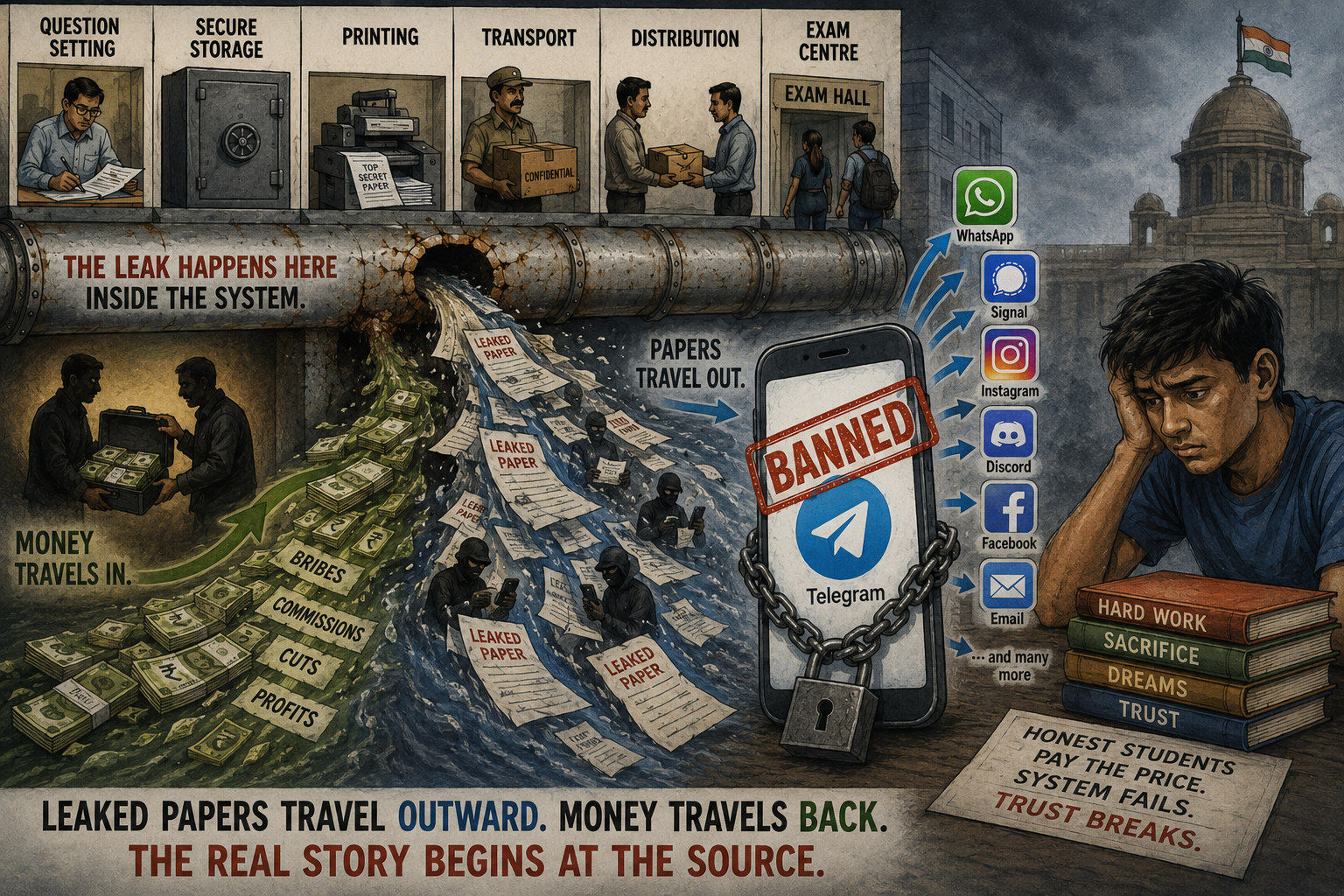
Every examination paper passes through a controlled chain of custody. Questions are set by authorised experts. Papers are stored in secure systems, printed under supervision, transported under protection, distributed according to prescribed procedure. At every stage, specific individuals and institutions are responsible for maintaining confidentiality. When a paper escapes that chain before the examination begins, there is only one question that matters: how did it get out of a system designed specifically to prevent that outcome?
Telegram did not get it out. Messaging applications do not generate examination papers. They do not have privileged access to confidential material. By the time leaked content reaches any platform, the breach has already occurred. The damage originates where confidential material left official custody. Not where it was subsequently shared.
Defenders of the ban will argue this misses the point. Their case is not that blocking Telegram prevents the original leak. It is that Telegram's architecture allows rapid mass distribution, and that in the hours before a high-stakes examination, even slowing that distribution could limit the number of candidates exposed to leaked material. Damage control, not prevention.
There is some force in that argument. Governments act under uncertainty. If a platform is being used extensively by cheating networks, restricting access for a few days may complicate their operations. That is a defensible position.
But it is also a concession of defeat. A system that blocks communication channels whenever examination security is threatened has already admitted that confidential material has escaped official control. The measure of an examination process is not how effectively authorities suppress leaked papers after the breach. It is whether those papers remained secure in the first place. Damage limitation may be necessary. It cannot become a substitute for accountability.
Even on its own terms, however, the effectiveness of the ban is limited. Information does not disappear because one platform is unavailable. It migrates. WhatsApp, Signal, Discord, email lists, cloud storage links - the modern information ecosystem is built on redundancy. Block one route and others open immediately. The result is that authorities inconvenience millions of ordinary users without meaningfully address the networks responsible for the original leak. Pavel Durov said as much. He has an obvious interest in saying it, but he is right.
The government also cites misinformation. Fake messages were causing anxiety among students. That is true and worth taking seriously. But misinformation thrives in environments where institutional trust has already collapsed. When students doubt official assurances, rumours fill the vacuum. Restricting platforms does not restore that trust. Transparent investigations do. Timely, accurate communication does. A track record of not repeating the same crisis does.
There is a broader pattern here that deserves to be named. Whenever a systemic failure occurs, attention shifts toward external actors whose role is secondary. Technology companies and digital platforms are visible, often unpopular, and easier to act against than internal administrative failures. Targeting them generates headlines. Identifying which individuals within the examination system facilitated a leak, prosecuting them and redesigning the procedures that allowed the breach - none of that generates dramatic headlines. All of it is more likely to produce lasting change.
The students who sit NEET have invested years of effort under enormous financial and emotional pressure. Their families have made sacrifices. When allegations of leaks emerge, what is at stake is not just administrative embarrassment. It is the question of whether merit still determines outcomes in this country. Honest candidates deserve better than a government that bans an app and calls it action.
No messaging application can leak a paper that never left authorised hands. Until the institutions responsible for conducting these examinations direct their attention toward the points where confidentiality is actually breached, India will keep repeating this cycle. New platforms will be blamed. New restrictions will be imposed. The underlying failure will remain untouched.
The lead image is AI-generated